Palm diseases in Lee County: what's killing the queens, sabals and dates
Most 'dying' palms in Cape Coral are hungry, not sick. The ones that are sick usually can't be saved. This guide is how to tell the difference — and what to do about the palms next door.
First, the ones that aren't diseases
Cape Coral's fill soil is alkaline, sandy and short on the nutrients palms need, so nutrient deficiencies are far more common than disease and they look alarming. Potassium deficiency shows as orange or yellow flecking on the oldest, lowest fronds, which then die early — nearly every queen palm in the city has it. Manganese deficiency ("frizzle top") shows on the newest fronds: yellow, stunted, with frizzled, necrotic tips, common on queens and royals. Magnesium deficiency is a yellow band along the edges of older fronds with a green center. All three respond to a slow-release palm fertilizer with the right ratio — and all three get worse if a crew hurricane-cuts the palm and removes the fronds it's drawing reserves from. If the spear leaf (the newest, unopened frond at the center) is alive and green, the palm is usually feedable.
Ganoderma butt rot
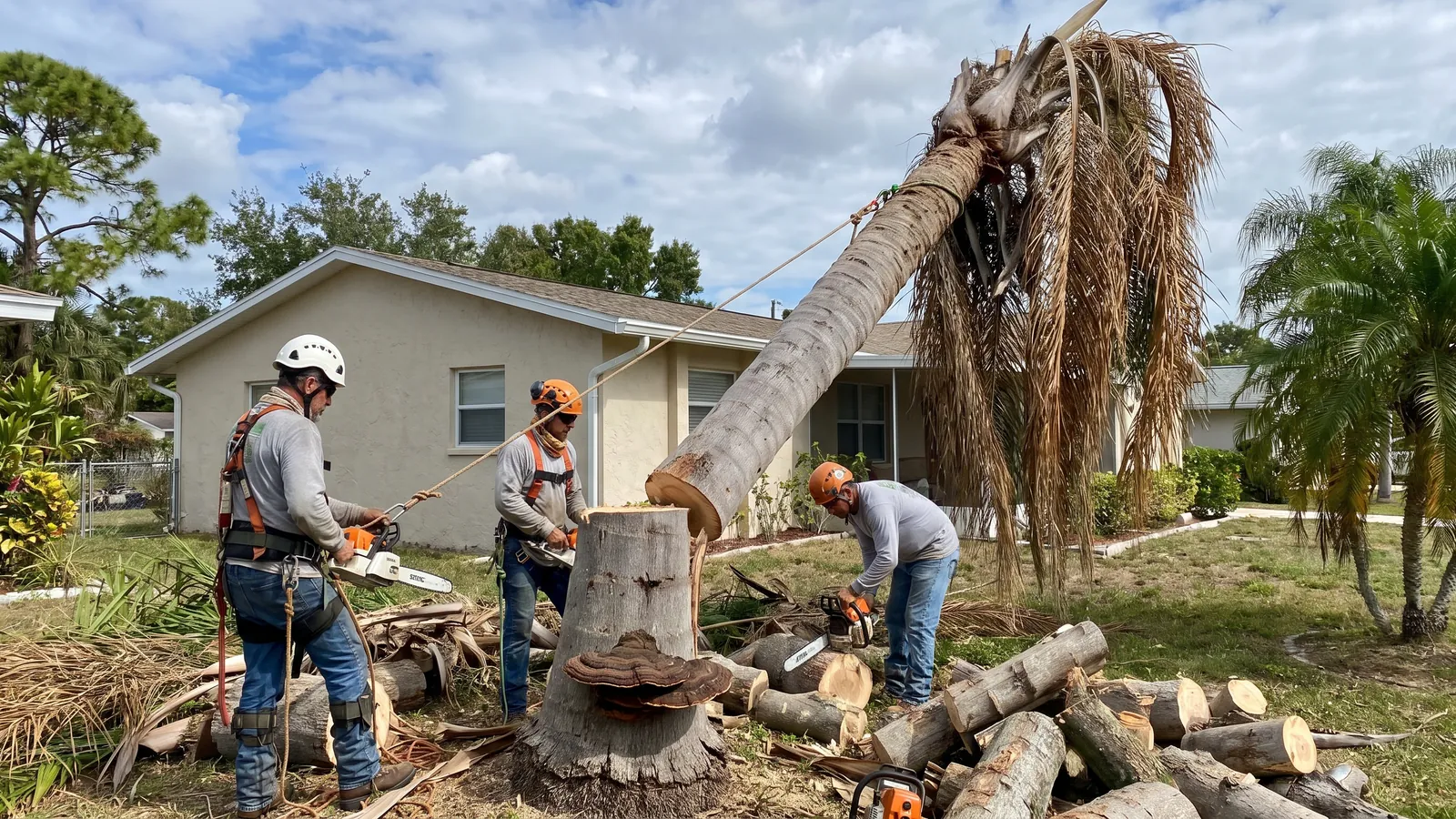
A soil fungus that infects the lower trunk and rots it from the inside. It attacks every palm species in Florida; queens and Canary Island date palms are the most vulnerable in Lee County. The only reliable sign is the conk — a hard, shelf-like bracket at the base of the trunk, white at first, then brown on top with a white edge. By the time a conk appears the inside of the lower trunk is already decayed and the palm can snap there in a storm. Earlier signs are subtle: wilting, slowed growth, lower fronds dying in order. There is no fungicide. The palm comes down, the lower four or five feet of trunk and the stump are hauled to the landfill — not chipped, not ground, because the spores spread — tools are disinfected, and no palm should be replanted in that spot. Any other tree is fine there.
Lethal bronzing
A phytoplasma — a bacterium without a cell wall — carried by a planthopper and known for years as Texas Phoenix palm decline. It kills Phoenix (date) palms, sabal palms, queen palms, Bismarck palms and more, and it has spread across Florida since 2006; it's confirmed in Charlotte and Sarasota counties and found in Lee. The sequence: fruit and flowers drop early, the oldest fronds turn bronze or reddish-brown from the tips inward, and then the spear leaf dies — once the spear is dead the palm is gone, usually within months. Confirmation is a lab test on a trunk core. There's no cure; the response is to remove infected palms promptly so the planthoppers don't carry it to the neighbors, and to protect valuable susceptible palms nearby with oxytetracycline trunk injections every few months — a preventive, not a treatment.
Lethal yellowing
A related phytoplasma that kills coconut palms (and some others) in the warmest parts of the state. Coconuts drop early, fronds yellow from the oldest up, the spear dies and the crown collapses within about six months of the first symptom. Same story: no cure, remove quickly, inject the valuable coconuts nearby if you want to keep them.
Fusarium wilt and Thielaviopsis
Fusarium wilt kills Canary Island date palms and queen palms, one side of the frond dying before the other — a brown stripe down one half of the rachis. It spreads on pruning tools, which is why ours are disinfected between every palm. Thielaviopsis trunk rot causes the crown to collapse with no warning, often after a wound; it's fatal and spikes on a climber's boots are one of the wounds, which is why we never spike a palm that's staying. Royal palm bug chews new spring growth on royals — ugly, not fatal, and the palm usually outgrows it.
What to do
- A conk at the base: removal, haul the base to the landfill, no palm in that spot again.
- Bronzed lower fronds and a dying spear on a sabal, queen or date: removal, promptly; consider injections for the neighbors.
- A coconut dropping nuts and yellowing from the bottom up: removal, promptly.
- Orange flecking or frizzled yellow new growth with a live spear: feed it, don't cut it.
- Any palm trimmed by a crew that didn't clean its tools: watch it for a season.
- Replanting after a loss: for a Ganoderma spot, anything but a palm; for a bronzing loss, a species the disease doesn't take — foxtail, royal, coconut (bronzing doesn't, yellowing does), or a native like a sabal kept injected.
Common questions
Is my queen palm dying or just ugly?
If the spear leaf is green and only the old fronds are orange or flecked, it's hungry — feed it. If the spear is dead, or there's a conk at the base, it's dying. Send a photo of the base and the crown; we'll tell you which.
Can Ganoderma spread through my yard?
Yes, by spores from the conk and through soil. Removing the conk early, hauling (not grinding) the infected stump, and not replanting palms in the spot limits it. Other palms in the yard aren't automatically doomed — just don't wound their trunks.
Should I inject my palms against lethal bronzing?
If you have valuable susceptible palms — big Canary Island dates, a row of sabals — and there's a confirmed case nearby, yes; oxytetracycline every three to four months, done by someone who knows the dose. It's prevention only, and it costs less than the palm.
What does a diseased-palm removal cost?
$150–$400 for a queen or foxtail, $200–$500 for a sabal, $500–$1,200 for a big royal, $600–$1,500 for a Canary Island date, plus $150–$400 for the landfill haul of a Ganoderma base.
Related: Palm removal · Palm trimming · Northeast Cape Coral · Tree removal cost