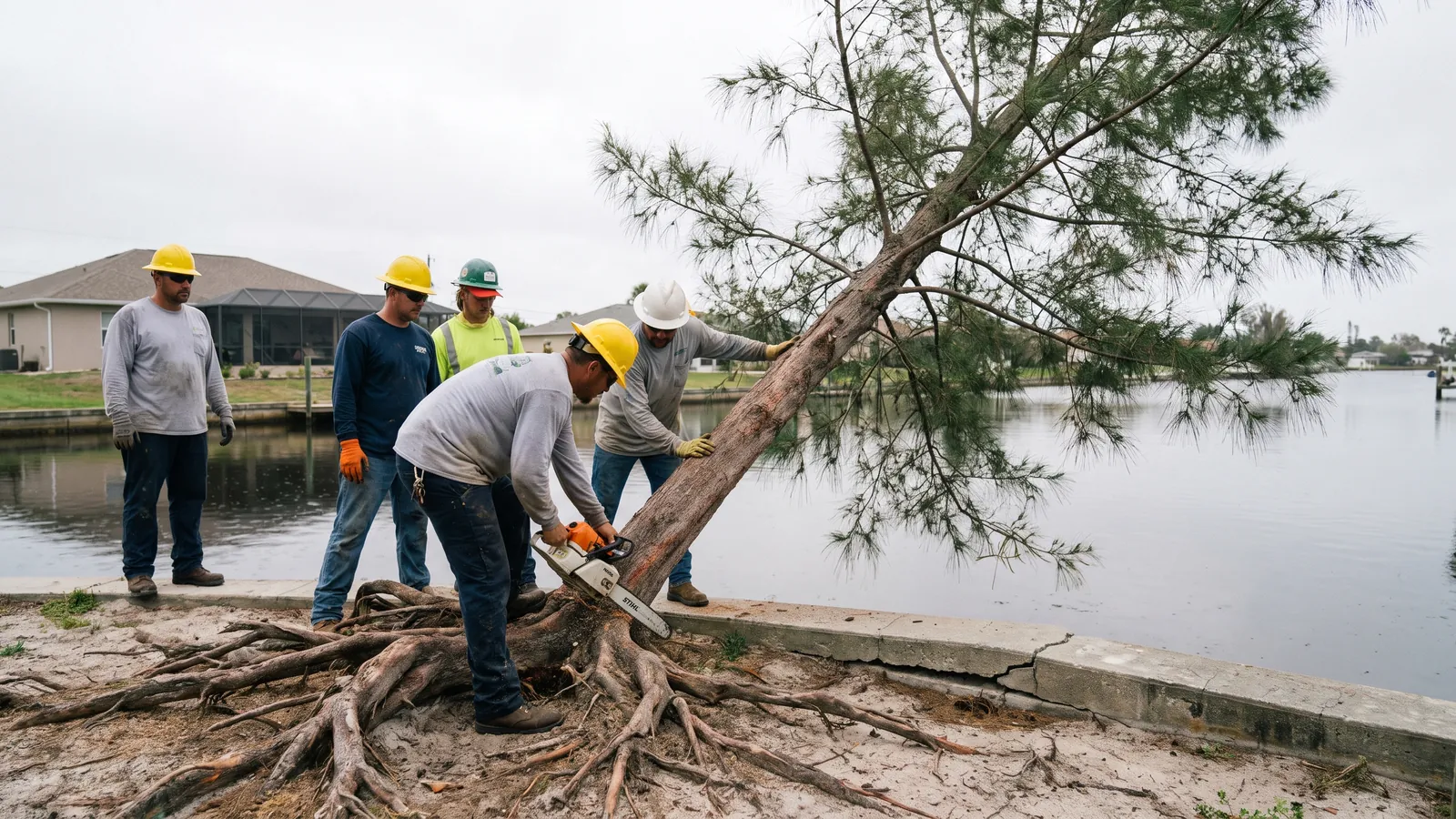
Most of the trees we remove in Cape Coral are one of five things: a slash pine that Ian rocked loose and the beetles finished, standing dead over a roof or a pool cage; an Australian pine on a canal lot, seventy feet tall on roots a foot deep, that the city lists as prohibited and the next storm will push into the house or the neighbor's dock; a ficus, black olive or mahogany planted in the 1960s or 70s in the south Cape whose roots are in the seawall cap, the septic drain field or the driveway; a queen, date or sabal palm killed by Ganoderma or lethal bronzing; or a healthy tree that is simply in the way of a pool, an addition or a new house on a North Cape lot.
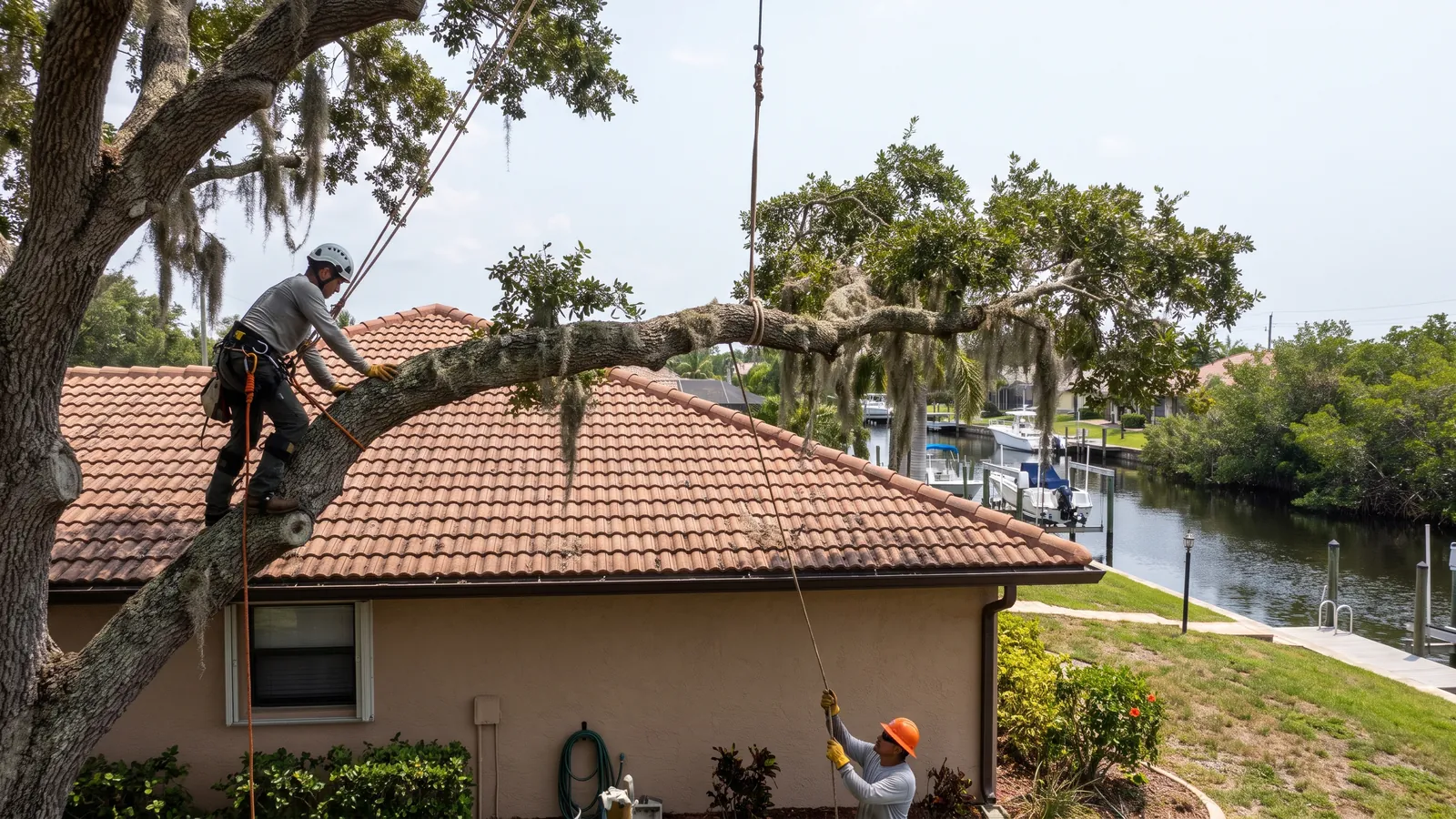
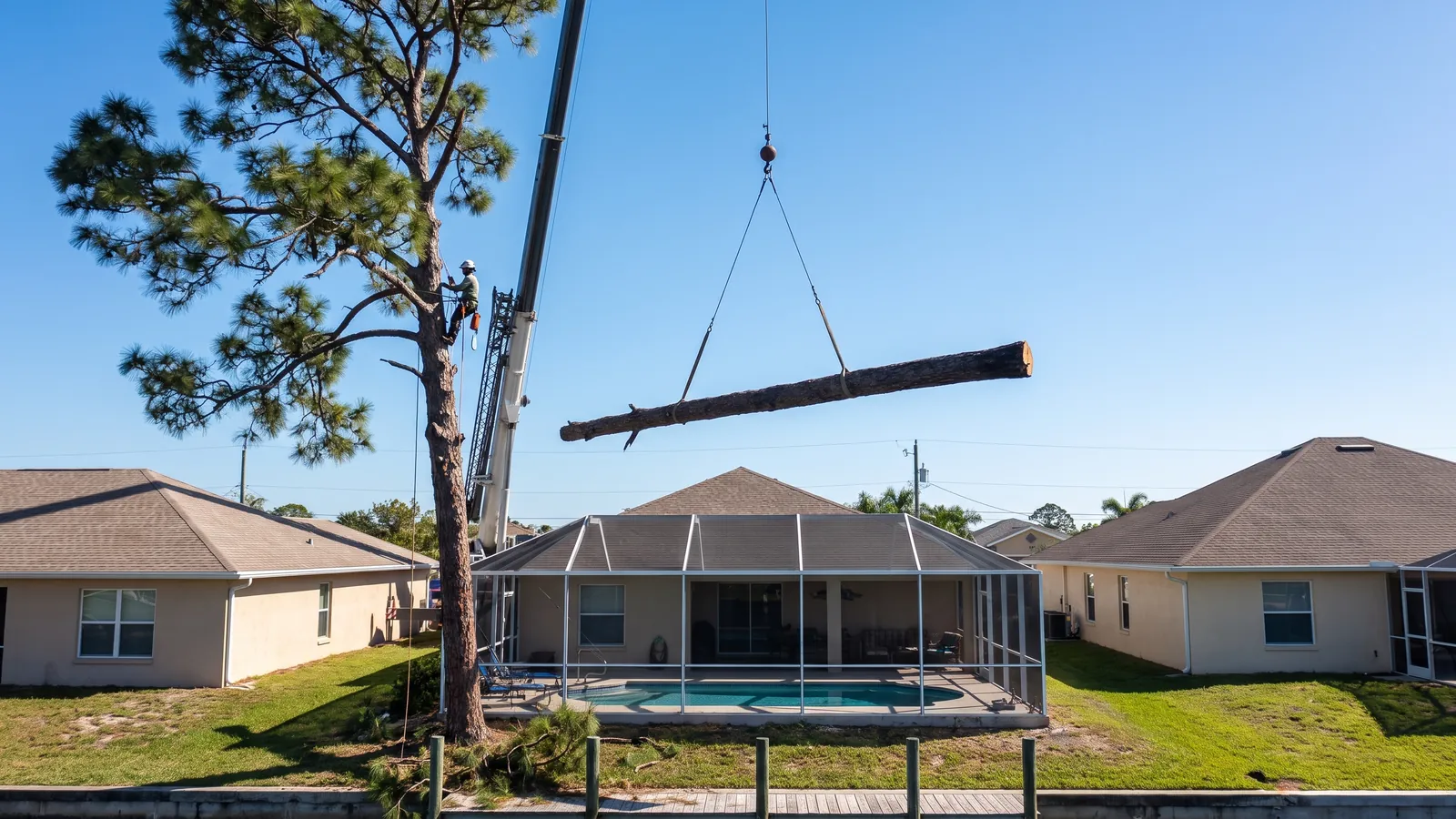
The job depends on the lot. Cape Coral's standard 80-by-125 lot puts the house, the pool cage, the seawall, the dock and the neighbor's house all inside a big tree's canopy, so almost nothing here is felled whole. A climber or a bucket operator takes the limbs and the trunk in sections, each one roped and lowered by a ground crew so nothing lands on the cage, the tile roof or the seawall and nothing goes in the canal. When there is no drop zone at all — a seventy-foot pine between the house and the water, a Norfolk Island pine over the lanai — a crane lifts the sections over the roof to the street. Everything is chipped on site and hauled, the lawn is raked, and the stump is ground if you want it. We don't leave the pile at the curb: Cape Coral's horticulture pickup won't take stumps, logs or anything a tree company cut, so hauling is part of every job.
Before any of that, our ISA Certified Arborist looks at the tree. Roughly half the "dead" trees we're called about are stressed, not dead, and a good number of the "dangerous" ones have a lean they've had for forty years. If the tree can stay with a prune, we say so. If it's a risk, we put it in writing — that letter is what F.S. 163.045 asks for, and it's the reason no city permit or replacement is required on your lot.
What's included
Arborist assessment first
An ISA Certified Arborist looks at the lean, the root flare, decay, the species and the storm history, and tells you whether the tree really needs to come down.
Rigged, not dropped
Limbs and trunk sections roped and lowered by a ground crew over roofs, pool cages, seawalls and docks — nothing in the canal.
Chipped & hauled
Everything we cut goes into the chipper and off the property; the city won't collect tree-company debris, so hauling is included.
Stump grinding
Ground below grade with Sunshine 811 called two business days ahead; chips hauled or left for mulch.
Rules checked
No city permit on a residential lot, but we check mangroves, owl and tortoise burrows, eagle zones and the lot's required-tree count before we cut — and Fort Myers, Sanibel and county rules outside the city.
Insured, in writing
General liability and workers' compensation; the certificate is available before you sign.
Tree removal cost in Cape Coral, FL
| Job | Typical price | Notes |
|---|---|---|
| Small tree, under 25 ft | $200 – $500 | Crape myrtle, young oak, small palm, Norfolk pine sapling |
| Medium tree, 25–50 ft | $500 – $1,200 | Most ficus, black olive, mahogany, mid-size pines |
| Large tree, 50–75 ft | $1,200 – $2,500 | Mature slash pines, big live oaks, Australian pines |
| Very large, 75 ft and up | $2,000 – $4,000 | The biggest pines and Australian pines; usually crane work |
| Palms | $150 – $1,200 | Queens and sabals at the low end, 60-foot royals and coconuts at the top |
| Australian pine on a seawall lot | $800 – $3,500 | Shallow roots, long trunk, usually sectioned over the water |
| Crane removal | $2,500 – $7,000 | Lot access, canal-side, 70-plus-foot trees over structures |
| Stump grinding (add-on) | $150 – $500 | $3–$5 per inch of diameter, $150 minimum |
| Emergency / after-hours | + $400 – $1,500 | Tree on a structure, blocking a road, on a service drop |
These are 2026 Lee County ranges so you can budget. Your written price is itemized — the climb or bucket work, rigging, chipping and haul-off, stump grinding, crane time, the wildlife and mangrove check — and good for 30 days.
Recent work
Questions we get about tree removal
Do I need a permit to remove a tree in Cape Coral?
Not on your own residential lot — Cape Coral doesn't require one for trimming or removal on private property, and F.S. 163.045 bars any local permit or replanting when an ISA arborist documents the risk. We still check the things the state regulates: mangroves on the canal edge (Professional Mangrove Trimmer required above 10 feet), burrowing owl and gopher tortoise burrows, bald eagle zones, and whether the tree is one your lot was required to plant at its certificate of occupancy. Fort Myers, Fort Myers Beach, Sanibel, Bonita Springs and unincorporated Lee County each have their own permit rules, and we handle those too.
Can you get the tree out without touching the seawall or the pool cage?
Yes — that's most of the job on a canal lot. Sections are roped and lowered to a landing zone we pick with you, usually the driveway or a cleared strip of lawn, and when there isn't one a crane lifts over the roof to the street. We don't drag logs across the seawall cap and nothing goes in the water.
What about the stump?
Grinding is a separate line on the estimate, usually $150–$500 depending on diameter. We call Sunshine 811 two business days ahead because Cape Coral's utilities, irrigation and — in the North Cape — the new UEP sewer lines run close to the surface. Ganoderma palm stumps get hauled, not ground into mulch, so the fungus doesn't spread.
Will you haul everything away?
Always. Cape Coral's curbside horticulture collection takes small bundled pieces from homeowners but specifically excludes stumps, logs, root balls, land-clearing debris and anything generated by a tree company. Hauling is in every price.
Can I leave a dead pine standing for the woodpeckers?
Away from anything it could hit, sure — a snag on a big North Cape lot is wildlife habitat. Over the house, the cage, the driveway or a power drop, no: a beetle-killed slash pine sheds limbs for a year and then the whole tree goes in a thunderstorm. Our arborist will tell you which you have.
How fast can you come?
Estimates within a day or two, work usually within a week, same day or next day for anything on a structure. After a storm we triage: trees on houses and blocking roads first, then service drops, then hangers and leaners.